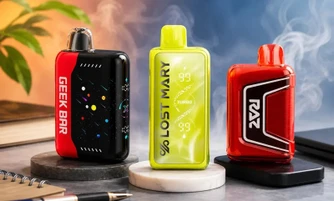
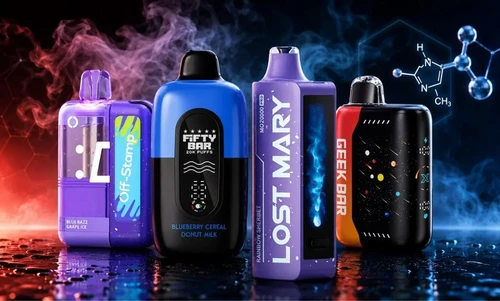
When you see 5%, 50 mg/mL, or 20 mL printed on a vape package, it isn’t always obvious how much nicotine the vape actually contains. The good news is that you only need two numbers to figure it out: the nicotine strength and the e-liquid capacity.
Multiply the strength in mg/mL by the amount of e-liquid in mL, and you get the device’s approximate total nicotine content. Below, we explain what common vape nicotine levels mean, how much nicotine a puff may deliver, how vaping compares with cigarettes, and why a higher puff count doesn’t necessarily mean more nicotine.
Table of contents
Key Takeaways
- Total nicotine = strength (mg/mL) × e-liquid volume (mL).
- To convert mg to %, divide by 10. 50 mg/mL = 5%. 20 mg/mL = 2%.
- U.S. disposable vapes like are usually 2%, 3%, or 5%, and 0% options exist.
- One puff delivers roughly 0.05 mg to 0.15 mg, depending on the device and your draw.
- A single disposable holds 100 mg to 1,000 mg or more, depending on tank size.
- The U.S. has no federal cap on nicotine strength. The UK and EU stop at 20 mg/mL.
- The label shows total content, not the dose your body absorbs.
How to Calculate the Nicotine in Any Vape
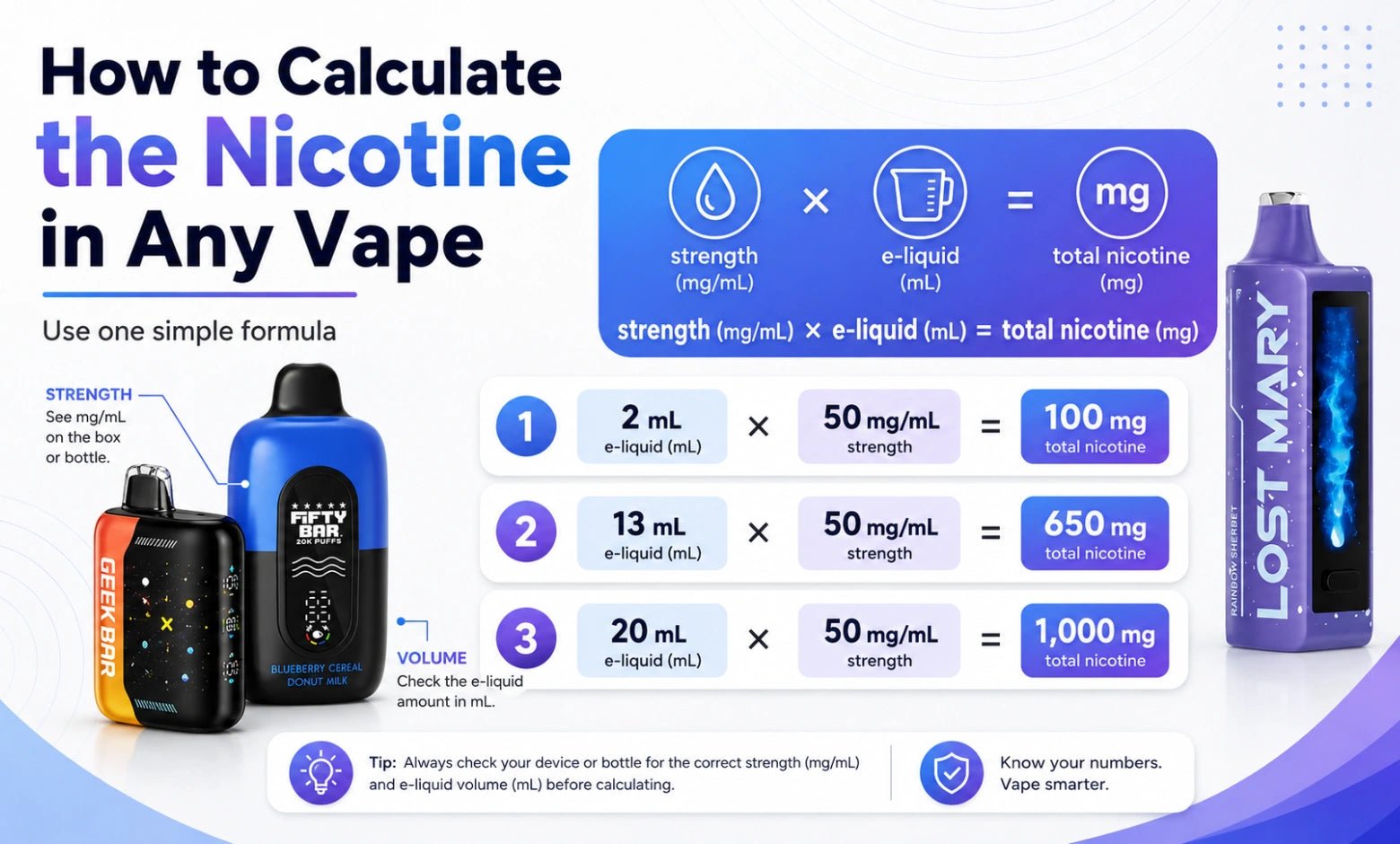
Multiply the strength by the volume of e-liquid inside the device. Both numbers are printed on the box, so the math takes about five seconds.
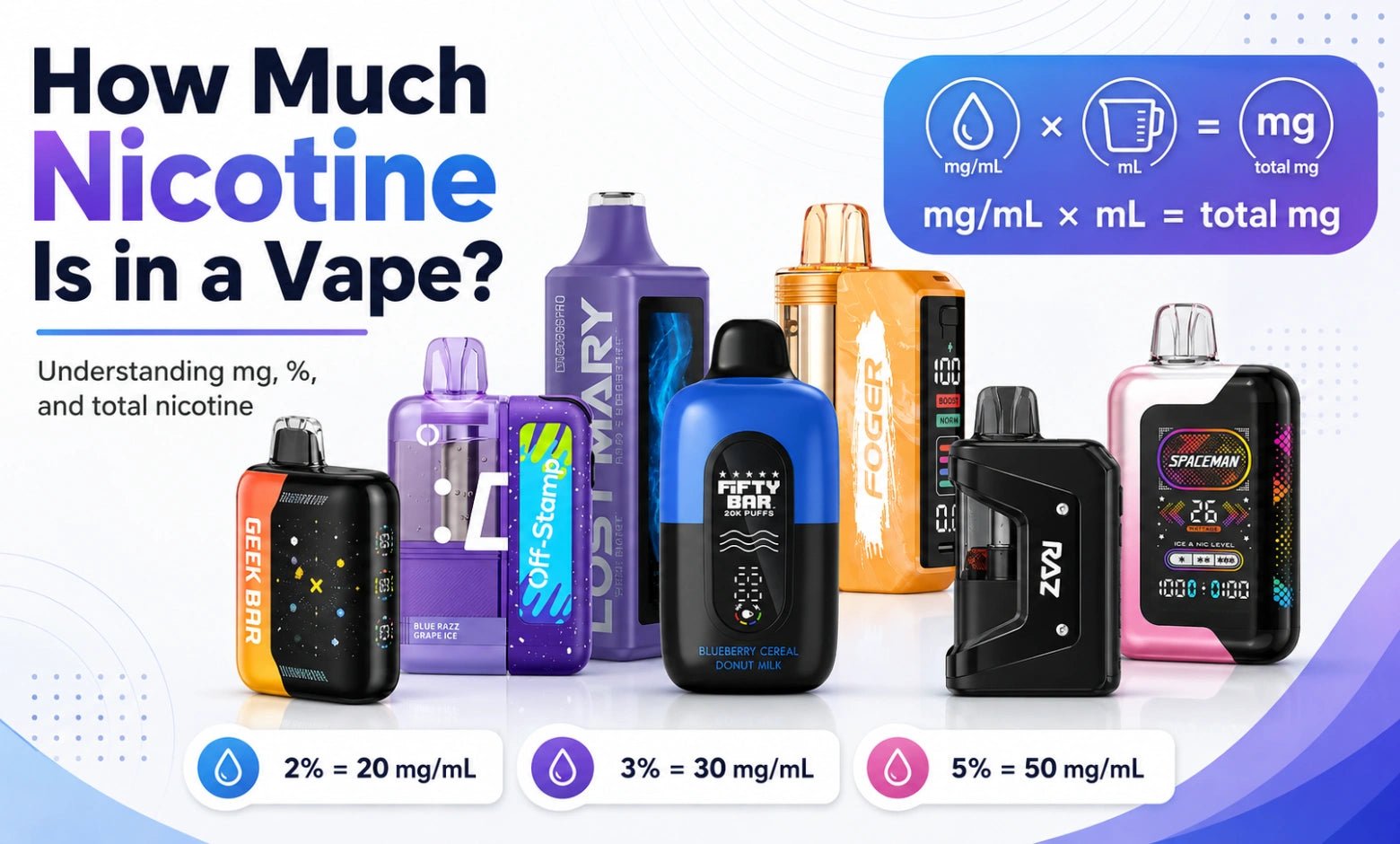
The formula: nicotine strength (mg/mL) × e-liquid volume (mL) = total nicotine (mg)
Here’s how that works out on three products we stock:
- A 2 mL pod at 50 mg/mL holds 100 mg of nicotine.
- A Lost Mary OS5000 carries 13 mL at 50 mg/mL, which comes to about 650 mg.
- A Lost Mary Quasar OS25000 carries 20 mL at 50 mg/mL, or roughly 1,000 mg.
The same formula works for bottled vape juice. A 30 mL bottle at 25 mg/mL contains 750 mg total.
One important distinction: the number on the label is total content, not the dose you receive. Over the life of a device, you’ll vaporize nearly all of that liquid, but you won’t absorb all of it. A meaningful share is lost to exhaled aerosol and to condensation inside the device, and your body only takes up part of what actually reaches your lungs. So a 650 mg disposable doesn’t put 650 mg into your bloodstream. It delivers considerably less, spread across days or weeks of use.
Vape Nicotine Levels Explained: mg vs. %
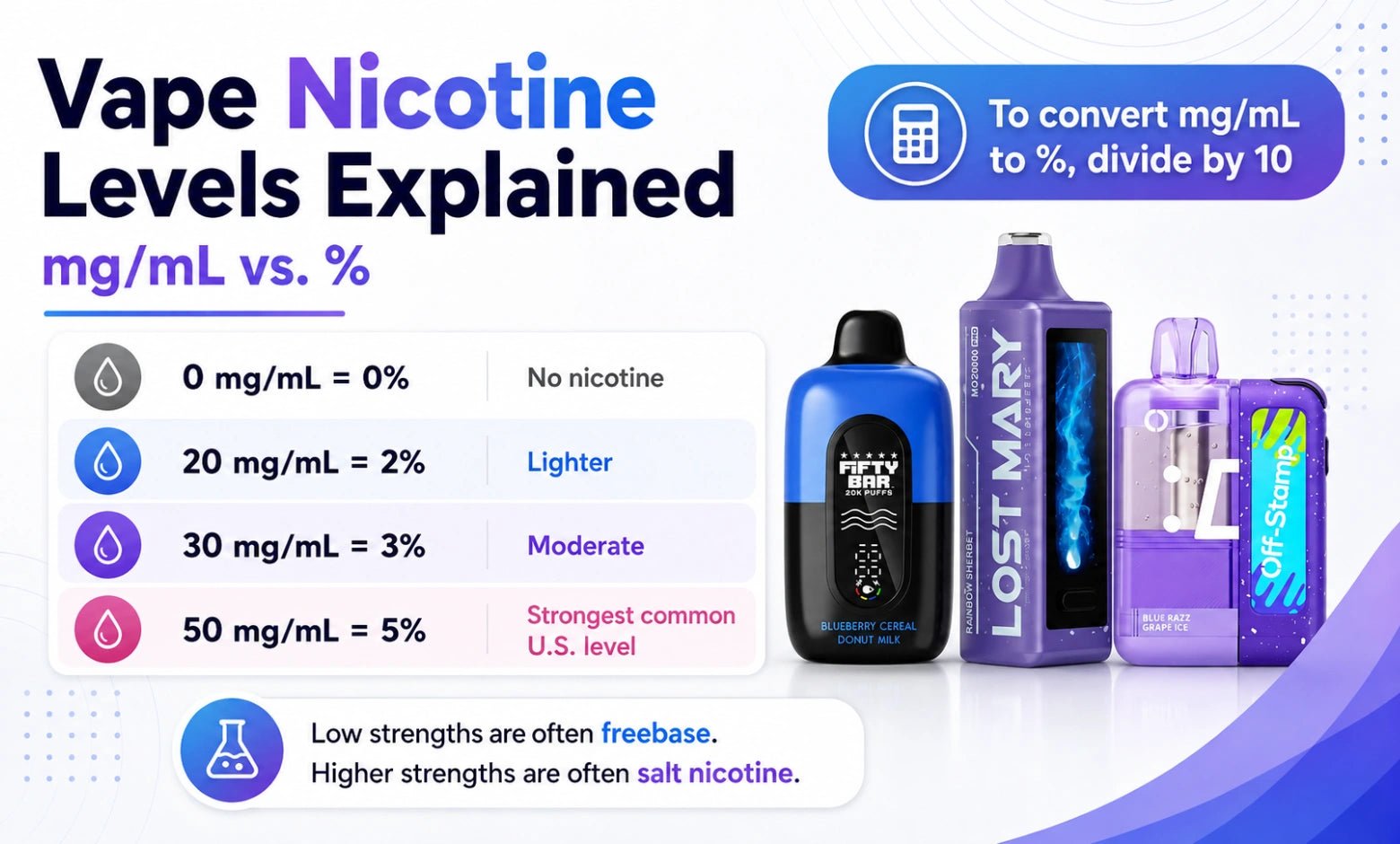
Labels show strength in two ways, and both describe exactly the same thing. One is milligrams per milliliter (mg/mL). The other is a percentage of the liquid by volume (%).
To switch between them, divide the mg number by 10. So 50 mg/mL is 5%, 20 mg/mL is 2%, and 3 mg/mL is 0.3%. To go the other direction, multiply the percentage by 10.
Here’s the full range you’ll encounter:
Strength |
Percentage |
Type |
Who it tends to suit |
0 mg/mL |
0% |
None |
Flavor only, no nicotine |
3 mg/mL |
0.3% |
Freebase |
Sub-ohm tanks and cloud-focused setups |
6 mg/mL |
0.6% |
Freebase |
Light freebase users on larger devices |
12 mg/mL |
1.2% |
Freebase |
Moderate use in refillable tanks |
20 mg/mL |
2% |
Salt |
Lighter or social users |
30 mg/mL |
3% |
Salt |
Moderate daily users |
50 mg/mL |
5% |
Salt |
Heavy users and former pack-a-day smokers |
Notice the split. Low numbers are almost always freebase nicotine in refillable devices. High numbers are almost always nicotine salts in disposables and pods. That difference matters more than most people realize, and we cover it below.
Is 5% Nicotine a Lot?
Yes, at 50 mg/mL, 5% is the strongest level commonly sold in the United States, and it’s 2.5 times the maximum allowed in the UK and EU. It’s intended for someone who smoked a full pack a day.
If you’re new to nicotine or coming from a lighter product, 5% will likely feel harsh. But the harshness isn’t the real problem. The real problem is that salt nicotine smooths out the throat, so a strength that would make you cough as freebase goes down easily. You can take in far more than you intended before your body tells you to stop.
Is 2% or 3% Nicotine a Lot?
2% is on the lighter end for U.S. disposables, though it’s the legal maximum in the UK and EU, which tells you something about how strong the American default is. At 20 mg/mL, it suits lighter or social users, and it’s the natural first step down from 5%.
3% (30 mg/mL) sits in the middle. It’s popular with people who want a noticeable hit without going all the way up, and it’s often the right fit for someone who was a light-to-moderate smoker rather than a pack-a-day one.
Nicotine Strength by Product Type
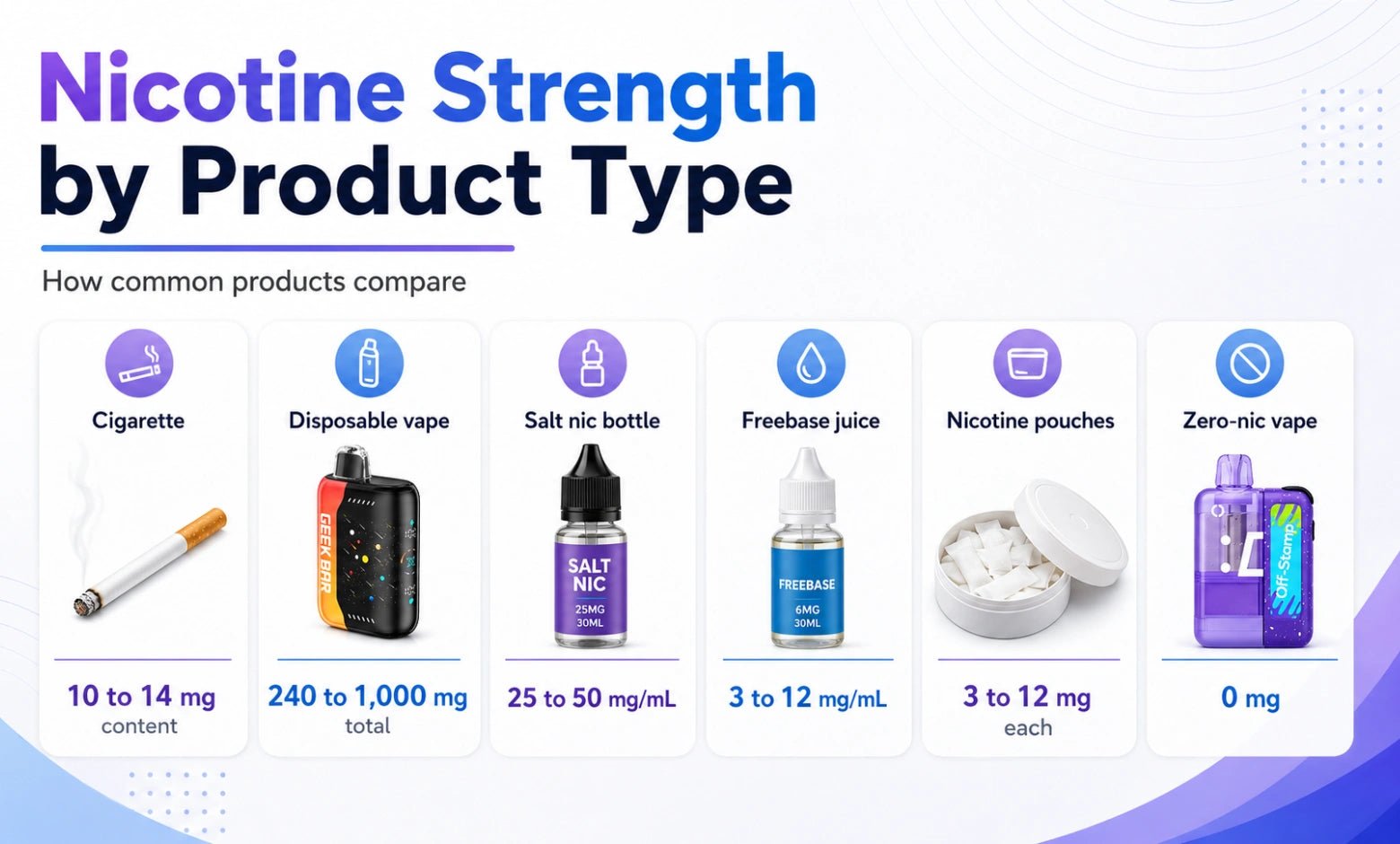
Vapes don’t exist in isolation. If you’re comparing options, or moving between them, here’s how the common nicotine products line up:
Product |
Typical nicotine |
What does that mean in practice |
Cigarette |
10 to 14 mg per stick (about 1 to 1.5 mg absorbed) |
Most of it burns off rather than reaching you |
Disposable vape (salt) |
20 to 50 mg/mL × 12 to 20 mL = 240 to 1,000 mg total |
Total content is large; delivery is spread over days |
Bottled salt nic juice |
25 to 50 mg/mL, usually 30 mL bottles |
Designed for pods and low-power devices |
Bottled freebase juice |
3 to 12 mg/mL, usually 60 mL bottles |
Designed for higher-power sub-ohm tanks |
3 to 12 mg per pouch |
Oral absorption, no inhalation, no vapor |
|
Zero-nicotine vape |
0 mg |
Flavor and draw only |
The row that surprises people most is the first one. A cigarette’s content is 10 to 14 mg, but a smoker only absorbs 1 to 1.5 mg of it. Nearly every misleading "one vape equals X cigarettes" claim comes from confusing those two numbers.
If you’re moving away from inhaling altogether, our nicotine pouch collection carries Pillowz in several strengths. Note that the milligram figure on a pouch tin is per pouch, not per milliliter, so it isn’t directly comparable to a vape number.
Why Are U.S. Vapes Stronger Than UK and EU Vapes?
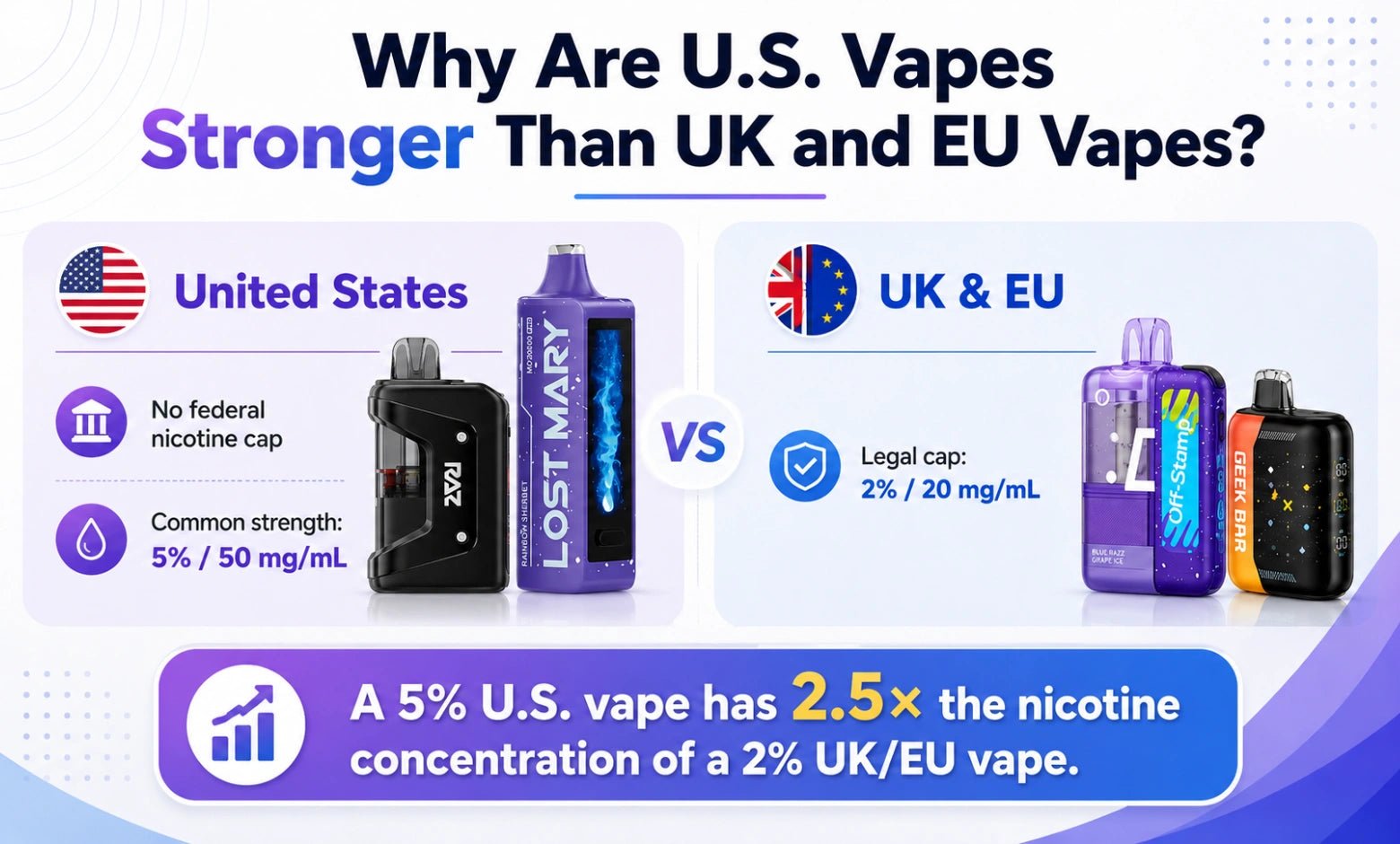
The UK and EU limit e-liquid to 20 mg/mL (2%) under the Tobacco Products Directive. That’s why a British disposable tops out at 2% while an American one commonly runs 5%. There isn’t a difference in device technology or coil design. It’s purely a difference in regulation.
The FDA regulates vapes as tobacco products and reviews them one at a time through the premarket authorization process, but it has never set a concentration limit the way Europe has.
The practical takeaway: a 5% U.S. disposable is 2.5 times the concentration of the strongest device legally sold in the UK. If you’re switching from a European device or reading vaping advice written for a UK audience, adjust your expectations. The numbers don’t translate, and neither does the guidance built on them.
How Much Nicotine Is in One Puff?
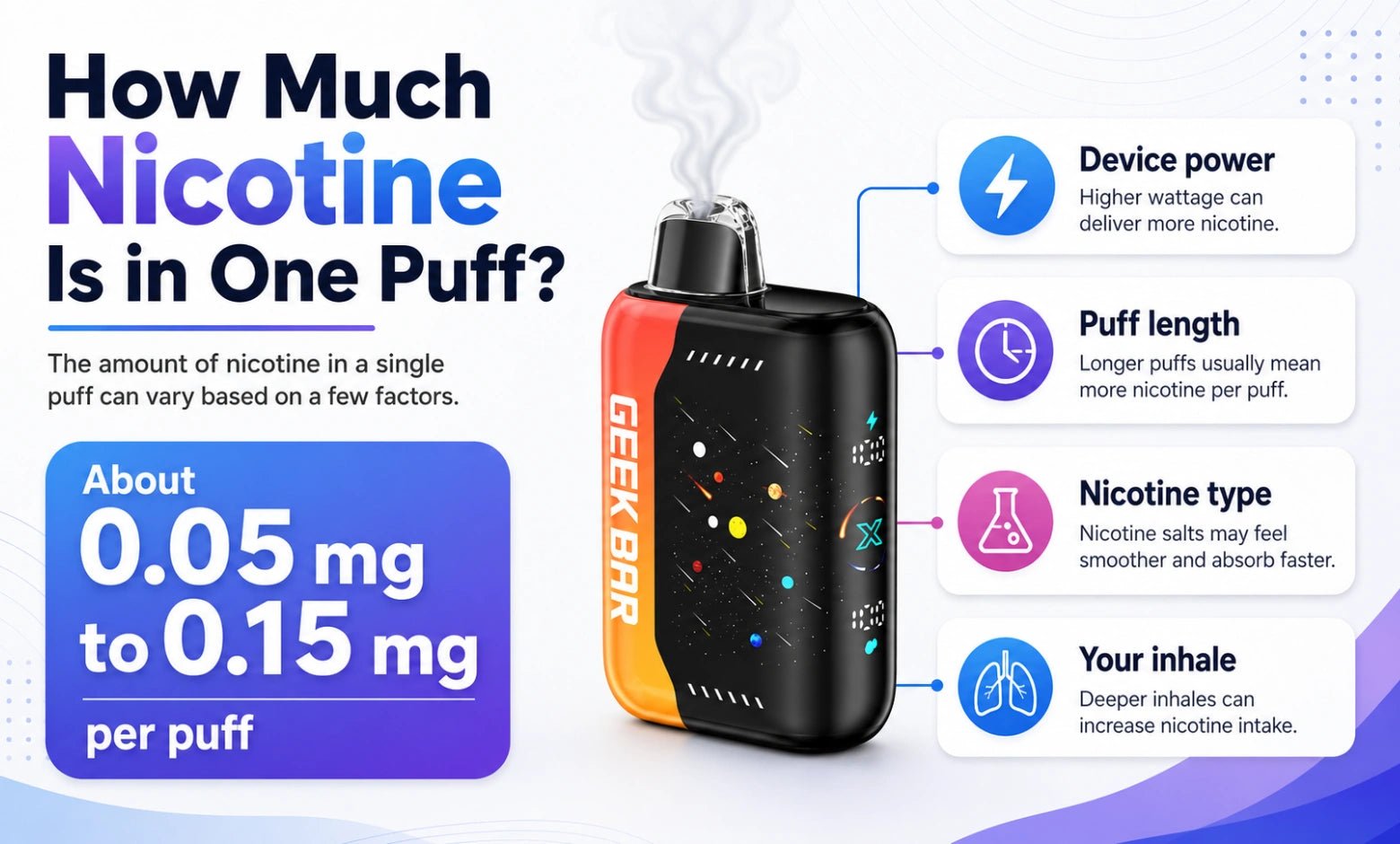
A single puff delivers roughly 0.05 mg to 0.15 mg of nicotine. That’s small on its own, but it adds up quickly across a day of steady use.
The amount isn’t fixed. Four things change it:
- Device power: A higher-wattage device vaporizes more liquid per second than a small pod, so each puff carries more.
- Puff length: A long, deep draw pulls significantly more vapor than a quick one.
- Nicotine type: Salt nicotine absorbs faster and feels smoother than freebase at the same strength.
- Your inhale: How deeply you pull and how long you hold it both affect how much your body actually takes up.
This is why two people can use the identical device and end up with very different daily intakes.
How to Estimate Your Own Daily Intake
Here’s a method that’s more useful than any per-puff average, because it uses your actual behavior instead of a lab figure.
Track how many days a device lasts for you, then divide. If a 13 mL Lost Mary OS5000 at 5% holds about 650 mg, and it lasts you five days, you’re going through roughly 130 mg of e-liquid nicotine per day. If the same device lasts you ten days, it’s 65 mg.
That number isn’t your absorbed dose, since you take up only part of it, but it works as a consistent yardstick. Watch it over a few devices, and you’ll see your real pattern, including whether a stressful week is quietly moving it upward. It also makes the effect of switching strengths concrete: dropping from 5% to 3% on the same device with the same habits cuts that figure by 40%.
Freebase vs. Nicotine Salts
Almost every disposable we carry uses nicotine salts. Bottled e-liquid for refillable tanks is more often freebase. Here’s how they compare:
Feature |
Freebase Nicotine |
Nicotine Salts |
Typical strength |
3 to 12 mg/mL |
20 to 50 mg/mL |
Throat hit |
Harsh at high strengths |
Smooth even when strong |
Absorption speed |
Slower |
Faster |
Best suited to |
Sub-ohm tanks, higher wattage |
Disposables, pods, low wattage |
Common bottle size |
60 mL |
30 mL |
Common in |
Salt nic juice, disposables |
Salts let you inhale a high strength without the throat burn that freebase would cause at the same concentration. That smoothness is comfortable, and it’s also the catch. A 50 mg/mL salt disposable can feel easy while delivering a genuinely strong dose. Freebase gives you a built-in warning signal at high strengths. Salts remove it.
There’s a practical rule buried in that table worth stating plainly: don’t put salt nic in a high-power sub-ohm device. Salts are formulated for low-wattage pods. Running 50 mg/mL through a sub-ohm tank vaporizes far more liquid per puff than the strength was designed for, and it’s an unpleasant, easily avoided mistake.
How Much Nicotine Is in a Disposable Vape?
Disposables vary widely because they come in different tank sizes. Nearly all are 5% (50 mg/mL), though a growing number offer 2%, 3%, and 0% versions.
Here’s how the math works out across devices we stock:
Device |
E-liquid |
Strength |
Approx. total nicotine |
Puff count |
12 mL |
50 mg/mL (5%) |
~600 mg |
||
13 mL |
50 mg/mL (5%) |
~650 mg |
||
13.5 mL |
50 mg/mL (5%) |
~675 mg |
||
16 mL |
50 mg/mL (5%) |
~800 mg |
||
16 mL |
50 mg/mL (5%) |
~800 mg |
||
16 mL |
50 mg/mL (5%) |
~800 mg |
||
16.5 mL |
50 mg/mL (5%) |
~825 mg |
||
18 mL |
50 mg/mL (5%) |
~900 mg |
||
20 mL |
50 mg/mL (5%) |
~1,000 mg |
The pattern is clear: the bigger the tank, the more total nicotine the device holds. Exact volumes can vary by model and production run, so treat these as close estimates.
Puff Count Is Not the Same as Nicotine Content
This trips up a lot of shoppers, and the table above shows exactly why.
Look at the RAZ LTX 25000 and the Geek Bar Pulse. One is rated for 25,000 puffs and the other for 15,000, but both hold 16 mL, and both contain about 800 mg of nicotine. The higher puff count doesn’t mean more nicotine. It means the device is rated to draw less liquid per puff, usually through a lower-power mode.
So if you’re browsing by puff count, you’re browsing by how long a device lasts, not by how strong it is. Strength and capacity are the two numbers that determine nicotine content. Puff count is a duration estimate layered on top.
What We See on the Labels, in Practice
We handle these devices every day, and there are a few things the box won’t tell you.
Advertised puff counts are lab estimates. They’re measured with short, uniform machine puffs under controlled conditions. Real-world use runs meaningfully lower, which means you’ll finish a tank faster than the number on the front suggests.
Capacity matters as much as strength. Two devices can both say 5%, but if one holds 13 mL and the other holds 20 mL, the second contains more than 50% more total nicotine. Strength tells you how concentrated the liquid is. Capacity tells you how much of it there is. Most people only read the first number.
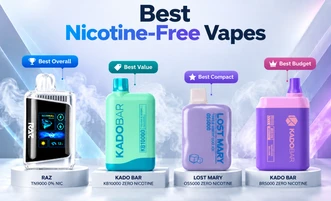
Lower-nicotine versions are usually the same device. When a model comes in 5% and 0%, it’s typically identical hardware with different liquid, so you get the same flavor lineup, the same draw, and the same battery. Our nicotine-free collection includes 0% versions of the Lost Mary MT15000 Turbo, the Lost Mary MT35000, and several Kado Bar models. If you want to step down, you rarely have to give up the device you like.
How Much Nicotine Is in Vape Juice and Pods?
Bottled e-liquid
Bottled juice makes the math especially easy, because the bottle states both numbers directly.
A 30 mL salt nic bottle at 50 mg/mL contains 1,500 mg total, which is more than most disposables.
A 60 mL freebase bottle at 6 mg/mL contains 360 mg total.
That comparison catches people off guard. The smaller bottle holds over four times the nicotine, because concentration matters far more than volume. It’s the same principle as the disposable table above, just more extreme.
Bottled juice is also where you get the most control. Salt nic typically comes in 30 mL bottles for pods and low-power devices (RAZ, Yogi Salt Nic, Coastal Clouds), while freebase comes in 60 mL bottles for sub-ohm tanks. Pick the strength that matches your device, not just your preference.
Refillable and prefilled pods
A pod usually holds 2 mL to 5 mL of e-liquid. At 50 mg/mL, a 2 mL pod holds about 100 mg of nicotine, or roughly a sixth of what a mid-size disposable carries.
Pods give you more control than disposables. You choose the strength, and you can refill or swap as your needs change, which makes a gradual step-down much easier to manage than buying whatever strength a disposable happens to come in.
How Many Cigarettes Are in a Vape?
There’s no clean conversion, and any site giving you an exact number is comparing the wrong things. Here’s why, and what you can compare honestly.
A cigarette contains roughly 10 to 14 mg of nicotine, but a smoker only absorbs about 1 to 1.5 mg of it. The rest burns off in sidestream smoke or stays in the unburned tobacco. Vapes work the same way: the label shows total content, not delivered dose.
That gives you two fair comparisons and one badly misleading one:
Comparison |
Fair? |
What it looks like |
Total content vs. total content |
✅ Yes |
A 650 mg disposable holds roughly the nicotine of 50 to 65 cigarettes |
Absorbed dose vs. absorbed dose |
✅ Yes |
Best estimated by puff count, not milligrams (see below) |
Total tank content ÷ absorbed cigarette dose |
❌ No |
This is where "one vape = 20 packs" headlines come from |
That third row is the mistake almost every comparison online makes. Dividing a device’s full 650 mg by the 1.5 mg a smoker absorbs from a cigarette mixes two different quantities and inflates the answer by roughly eight to ten times.
For a properly framed comparison, UC San Francisco notes that today’s popular disposables can carry the nicotine content of three cartons, or about 600 cigarettes. That’s a content-to-content figure, not a statement about how much you’d absorb.
How Many Puffs Equal One Cigarette?
Roughly 10 to 15 puffs: That number comes from behavior rather than chemistry: a smoker takes about 10 to 15 puffs to finish one cigarette, so matching that pattern is a practical way to gauge your intake.
Treat it as a rough guide. Nicotine from vapor and nicotine from smoke aren’t absorbed at the same rate, and research on nicotine delivery has generally found that vaping produces lower peak blood-nicotine levels than smoking, even at comparable strengths. Puff-for-puff counting gives you a useful ballpark, not an exact match.
If You’re Switching From Cigarettes
Two things tend to help. First, start at a strength that actually satisfies you. Going too low is the most common reason people drift back to cigarettes, because they end up chain-vaping to compensate and still feel unsatisfied. Second, consider a familiar flavor profile before branching out. Our tobacco and menthol collections exist largely for people making that transition, and plenty of them move on to fruit or mint once the switch has settled.
How to Pick the Right Nicotine Strength
Not every vape contains nicotine. Zero-nicotine disposables give you the flavor and the ritual with none of it, and we stock a full range.
If you do want nicotine, here’s a straightforward way to choose:
Your background |
Suggested strength |
Good starting point |
Never smoked, want flavor only |
0% |
|
Light or social use |
2% (20 mg/mL) |
Look for 2% versions of any device |
Moderate daily use |
3% (30 mg/mL) |
Mid-size rechargeable disposables |
Former pack-a-day smoker |
5% (50 mg/mL) |
When in doubt, start lower. It’s easy to move up if a strength doesn’t satisfy you. It’s much harder to move down once you’ve adjusted to 5%.
Stepping Down Without Switching Devices
If you’re trying to cut back, gradual work is better than abrupt for most people. Because many models come in more than one strength, you can do it without changing the device you already like:
Stage |
Strength |
What changes |
Weeks 1 to 4 |
5% (50 mg/mL) |
Baseline, so track how long one device lasts you |
Weeks 5 to 8 |
3% (30 mg/mL) |
40% less nicotine per mL, same flavor and draw |
Weeks 9 to 12 |
2% (20 mg/mL) |
Another 33% down, and most people barely notice by now |
Week 13 onward |
0% |
Flavor and ritual, no nicotine |
The reason to hold each stage for several weeks rather than days is compensation. Drop too fast, and you’ll simply puff more often, which cancels the reduction. Watching your device-lasts-how-many-days number tells you whether that’s happening.
Frequently Asked Questions
How much nicotine is in a vape?
It depends on two numbers: strength and volume. Multiply the mg/mL on the label by the mL of e-liquid inside. A 2 mL pod at 50 mg/mL holds 100 mg. A 20 mL disposable at 50 mg/mL holds about 1,000 mg.
Is 5% nicotine a lot?
Yes, at 50 mg/mL, 5% is the strongest level commonly sold in the U.S. and 2.5 times the maximum allowed in the UK and EU. It’s built for former pack-a-day smokers. If you’re new to nicotine, start lower.
Is 2% nicotine a lot?
No, it’s on the lighter end for U.S. disposables, though it’s the legal maximum in the UK and EU. At 20 mg/mL, it suits lighter or social users and anyone stepping down from 5%.
How much nicotine is in one puff of a vape?
About 0.05 mg to 0.15 mg. The exact amount depends on the device’s power, how long you draw, and whether the liquid is salt or freebase nicotine.
How many mg of nicotine are in a cigarette?
About 10 to 14 mg of total content, of which a smoker absorbs roughly 1 to 1.5 mg. The rest burns off. This is why comparing a vape’s total tank content to a cigarette’s absorbed dose produces such misleading numbers.
How many puffs of a vape equal one cigarette?
Roughly 10 to 15 puffs, because that’s about how many puffs a smoker takes per cigarette. It’s a behavioral guide rather than a nicotine measurement, since vapor and smoke are absorbed at different rates.
Is one puff of a vape equal to 20 cigarettes?
No, A single puff delivers about 0.05 to 0.15 mg, a small fraction of one cigarette. The "one vape equals 20 cigarettes" claim refers to a whole device’s total content, not a single puff.
Does a higher puff count mean more nicotine?
No, Puff count estimates how long a device lasts, not how strong it is. A 25,000-puff device and a 15,000-puff device that both hold 16 mL at 5% contain the same 800 mg of nicotine.
Does every vape contain nicotine?
No, Zero-nicotine (0 mg) disposables deliver flavor and the draw with no nicotine at all. The strength is always printed on the label, so check the box. Our nicotine-free collection is entirely 0%.
How much nicotine is in a Geek Bar or Lost Mary?
Most are 5% (50 mg/mL). Total content depends on tank size. A 13 mL Lost Mary OS5000 holds about 650 mg, an 18 mL Geek Bar Pulse X about 900 mg, and a 20 mL Quasar OS25000 about 1,000 mg.
How much nicotine is in a bottle of vape juice?
Multiply the strength by the bottle size. A 30 mL salt nic bottle at 50 mg/mL holds 1,500 mg. A 60 mL freebase bottle at 6 mg/mL holds only 360 mg, despite being twice the size.
Why are U.S. vapes stronger than UK vapes?
Because the U.S. has no federal nicotine cap. The UK and EU limit e-liquid to 20 mg/mL (2%) under the Tobacco Products Directive, while U.S. disposables commonly run 50 mg/mL (5%).
Do nicotine salts contain more nicotine than freebase?
Usually, yes, by concentration. Salts typically run 20 to 50 mg/mL versus 3 to 12 mg/mL for freebase. Salts also feel smoother at high strengths, which can make a strong dose easy to underestimate.
The Bottom Line
Every nicotine question about a vape comes back to two numbers on the box: strength and volume. Multiply them, and you have the total. Divide the strength by 10, and you have the percentage. Per-puff estimates, cigarette comparisons, and step-down plans all build on those two figures.
What the label won’t tell you is the difference between what a device holds and what you absorb. Total content is a specification. Your actual intake depends on how you vape, and that part stays in your hands.
Ready to shop with the numbers in mind? Browse our full range of disposable vapes and rechargeable disposables, or go by brand across Geek Bar, Lost Mary, RAZ, and Kado Bar at VapeBarUSA. Prefer to control the strength yourself? Start with bottled vape juice. Want none at all? Our nicotine-free collection has 0% versions of devices you already know. Shopping on a budget? Try vapes under $10.
New here? First-time customers get $10 off orders over $35.
Disclaimer: This article is for general information only and is not medical advice. Nicotine content figures are based on manufacturer specifications and may vary by model and production run. If you have questions about nicotine use, dependence, or quitting, speak with a healthcare professional.
You must be 21 or older to purchase. WARNING: This product contains nicotine. Nicotine is an addictive chemical.